PIXELS is Patrick Jean’ latest short film, shot on location in New York. It chronicles the mayhem that happens when 8-bit creatures invade New York.
Saturday, April 10, 2010


Monday, April 5, 2010
Nieto/Sobejano via Studio Banana TV
Studio Banana TV interviews the Madrid-Berlin based architects Nieto-Sobejano about their project for the refurbishment of the Moritzburg Castle Museum Extension in Germany.
The ancient Moritzburg Castle in the city of Halle is a highly valuable example of Gothic military architecture in late 15th century Germany. Inevitably, its tumultuous history is reflected in the highly varied operations that have gradually changed it over the centuries. In spite of these numerous alterations, the building still maintains the formal structure of its main original architectural components: the perimeter wall-precinct, three of the four circular towers at the corners and the central parade ground.
The partial collapse of the north and western wings during the 17th century Thirty Year War gave rise to the centuries-long association between this castle and the romantic image of a ruin, which has survived down to the present day. With the exception of an unbuilt project by Friedrich Schinkel in 1828, to date there have been no proposals for a total operation to transform and expand the former ruins for the Art Museum housed inside since 1904.
An impressive collection of modern art, primarily German Expressionism, which includes paintings of Halle by Lyonel Feininger, will now be enlarged with the Gerlinger Bequest, one of the most valuable private collections of the Die Brücke expressionist group.
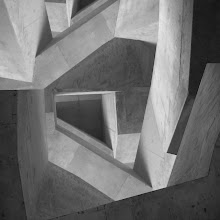
Our proposal for the extension is based on a single, clear architectural idea. It involves a new roof, conceived as a large folded platform that rises and bends to allow natural light to enter and also to hang the new exhibition areas. As a result of this operation, the entire floor area of the former ruin is freed up to generate a single space that permits different exhibition arrangements. This solution is supplemented with the construction of two new vertical communication cores. The first one is set in the north wing, resolving the connection between the different levels. In addition, a modern 25 metre high “tower” is built on the site of the demolished bastion to form an entrance core for the new exhibition spaces, looking out towards the views of the distant city.
The new landscape of roofs and metal towers converses through its angular geometry with the irregular volumetrics of the tall existing Castle roofs. Like the disturbing, expressive shapes painted by Feininger, the new fragments are added to the ongoing transformation process that has characterised the history of Moritzburg Castle over time.
Via: Studio Banana TV
Sunday, March 28, 2010
Wednesday, March 17, 2010
Book Review...Provisional

The success of this book is that it clearly illustrates a variety of very distinct modes of building a young architectural practice. Each mode/firm is different in that that they focus on very unique aspects of the architectural process or profession from visualization, consulting, design build, exhibition design, information design, et cetera - et cetera.
The book is broken up into several sections whereby the firms are first interviewed about there opinions on architecture and their personal working methodology; after which, they then illustrate these concepts through early schematic diagrams, working drawings, and construction photos.
I really appreciate the systematic approach to this book an how it allows the reader a clear understanding of the differences and similarities between the nine firms overall working methodology, schematic approach, project documentation, and process of construction.
After reading this book I came away with a much greater excitement for the future of the architectural profession. I highly recommend reading it.
Amazon Information:
Product Description:
Provisional profiles nine of the United States' most exciting architectural practices. They all share a pragmatic, 'roll-up-your-sleeves' approach that seeks opportunities to redefine the role of craft in architectural practice. Enlightening interviews together with a selection of drawings, diagrams, models, renderings, and building process photographs reveal a shared commitment to experimentation and learning-by-doing. Projects by SHoP Architects, Front Studio, Gehry Technologies, Lewis.Tsurumaki. Lewis, H weler + Yoon Architecture, nARCHITECTS, servo, GYA Architects, and Chris Hoxie Design are included as well as the following projects: Beijing National Stadium, China Central Television (CCTV) Station and Headquarters (Beijing), Dee and Charles Wyly Theater (Dallas); FutureGen Power Plant (Illinois); Highline HL23 (New York City); and the Olympic Sculpture Park (Seattle).
Paperback: 288 pages
Publisher: Princeton Architectural Press; 1 edition (October 7, 2009)
Language: English
ISBN-10: 1568988788
ISBN-13: 978-1568988788
Product Dimensions: 10.7 x 8.1 x 0.9 inches
The High Line by Brooklyn Digital Foundry
The High Line from Brooklyn Digital Foundry on Vimeo.
I am not sure how many of you have seen this video but i thought i would post it anyway since it is so well done.
The video was created by Brooklyn Digital Foundry
Sunday, February 14, 2010
Peter Zumthor: Therme Vals
On the 14th January 2010, the Velux Stiftung presented the second Daylight-Award at the S AM Swiss Architecture Museum in Basel. The presentation was realized in collaboration with the Department of Architecture of the Swiss Federal Institute of Technology (DARDEN ETH), Zürich and the S AM Swiss Architecture Museum.
Winner of the Daylight-Award 2010 is the Therme Vals of Peter Zumthor in Vals, Switzerland. Two honorary awards go to James Turrell for his Skyspace Piz Uter in Zuoz and to Isa Stürm Urs Wolf Architects for the Kunst(Zeug)Haus in Rapperswil, both in Switzerland. An additional honorary award for her important contribution to a better understanding of the effects of daylight to the human organism and its health goes to Prof. Anna Wirz-Justice, a chronobiologist of the University Basel, Switzerland. The Daylight-Award aims to encourage developers, planners and specialists to systematically use daylight in order to increase quality of life and energy efficiency.
VernissageTV realized three short documentaries for Velux Stiftung about the awarded works. The videos are already available at the Velux Stiftung website and will be published on VernissageTV within the next days.
In this video we have a look at the project that was awarded the first prize, Swiss architect Peter Zumthor’s Therme Vals. In his studio in Haldenstein / Switzerland, the architect speaks about this work, focusing on the aspect of daylight. The Jury states: “The building is exceptional, already a ‘classic’. It is still perceived as the most accomplished project in terms of daylight due to an archaic, minimalistic layout and an outstanding interplay with light and darkness. The architecture controls the light in a wonderful way, it is judged as a magnificent project.” According to the jury the architect Peter Zumthor became an artist dealing with daylight.
Peter Zumthor is one of the most famous contemporary architects. In 2009 he won the Pritzker Prize. Among his most known works are Therme Vals, Art Museum Bregenz, and Kolumba Museum in Cologne.
The Velux Stiftung was established in 1980 and promotes projects investigating the effect and better utilization of daylight. The Velux Stiftung is interested in the effect of daylight on the well-being of humans and on the recovery process from both physical and psychological illness, but also its impact on nature, and in technologies for the utilization of daylight in buildings for energy efficiency and illumination.
Peter Zumthor: Therme Vals / Interview. Vals and Haldenstein / Switzerland, December 15, 2009.
Via: Vernissage TV
Thursday, February 11, 2010
Wednesday, January 27, 2010
Joshua Prince-Ramus: Building a Theater That Remakes Itself
Joshua Prince-Ramus believes that if architects re-engineer their design process, the results can be spectacular. Speaking at TEDxSMU, Dallas, he walks us through his fantastic re-creation of the local Wyly Theater as a giant "theatrical machine" that reconfigures itself at the touch of a button.
via: TED
Tuesday, January 26, 2010
Video: Lemonade
So... I am not sure why I have two posts about getting laid off back-to-back. I guess I am just assuming that most architects and designers might find this topic of interest.
Watch this great documentary about the upside of getting laid off.
Video Description:
After a 37 year-old copywriter is laid off from a large ad-agency in 2008, he starts a blog for other unemployed ad professionals. Once the site launched, he decided to create a promotional video featuring the faces and stories of other laid-off execs.
Watch this great documentary about the upside of getting laid off.
Video Description:
After a 37 year-old copywriter is laid off from a large ad-agency in 2008, he starts a blog for other unemployed ad professionals. Once the site launched, he decided to create a promotional video featuring the faces and stories of other laid-off execs.
Sunday, January 24, 2010
New York Times: Architect, or Whatever
 At the Ballard Farmers’ Market in Seattle on a recent weekend, passers-by could be forgiven for thinking John Morefield was running for political office. Smiling, waving and calling out hellos to everyone who walked by his stand, he was the picture of friendliness. All he needed was campaign buttons and fliers.
By KRISTINA SHEVORY
Published: January 20, 2010
In fact, Mr. Morefield, 29, is no politician, but an architectural designer looking for work. He was seated at a homemade wooden stand under a sign reading “Architecture 5¢,” with a tin can nearby awaiting spare change. For a nickel, he would answer any architectural question.
In 2008, Mr. Morefield lost his job — twice — and thought he could ride out the recession doing design work for friends and family, but when those jobs dried up, he set up his stand. As someone in his 20s without many contacts or an extensive portfolio, he thought he might have an easier time finding clients on his own.
“I didn’t know what I was going to do,” Mr. Morefield said. “I had no other option. The recession was a real kick in the shorts, and I had to make this work.”
A troubled economy and the implosion of the real estate market have thrown thousands of architects and designers out of work in the last year or so, forcing them to find or create jobs. According to the latest data available from the Department of Labor, employment at American architecture firms, which peaked last July at 224,500, had dropped to 184,600 by November.
“It’s hard to find a place to hide when the economy goes down,” said Kermit Baker, the chief economist at the American Institute of Architects. “There aren’t any strong sectors now.”
And it’s not clear when the industry will recover. Architecture firms are still laying off employees, and Mr. Baker doesn’t expect them to rehire until billings recover, which he thinks won’t be until the second half of this year at the earliest.
In the meantime, many of those who have been laid off are discovering new talents often unrelated to architecture.
When Natasha Case, 26, lost her job as a designer at Walt Disney Imagineering about a year ago, she and her friend Freya Estreller, 27, a real estate developer, started a business selling Ms. Case’s homemade ice cream sandwiches in Los Angeles. Named for architects like Frank Gehry (the strawberry ice cream and sugar cookie Frank Behry) and Mies van der Rohe (the vanilla bean ice cream and chocolate chip cookie Mies Vanilla Rohe), they were an immediate hit.
“I feel this is a good time to try new things,” said Ms. Case, who did a project on the intersection of food and architecture while studying for her master’s in architecture at the University of California, Los Angeles, in 2008. “You do things you always wanted to do, something you’ve always been passionate about.”
Since she and Ms. Estreller rolled out their truck, Coolhaus, at the Coachella Valley Music and Arts Festival near Palm Springs last April, they’ve catered events for Mr. Gehry’s office, Walt Disney Imagineering and the Disney Channel.
Their initial investment was low: they bought a 20-year-old postal van on Craigslist and had it retrofitted and painted silver and bubblegum pink, all for $10,000. With seven full- and part-time employees, they now make enough to support themselves and have plans to expand (a Hamptons truck is in the works and they are trying to get their products into Whole Foods stores).
Leigh Ann Black was working as an architectural designer in Seattle when she lost her job over a year ago. After a long struggle to find work, she finally moved back to her hometown of Water Valley, Miss., in June, to take care of her sick grandmother.
Ms. Black, 30, is now living above her parents’ garage, but she finally has time to indulge her love of pottery. She recently converted an old horse barn on her family’s farm into a studio, plans to apprentice with local potters and has applied to several post-baccalaureate ceramics programs, with the hope of selling her wares at farmers’ markets and someday teaching art.
“This is not where I imagined I’d be when I turned 30, but I feel really inspired being back,” she said. “There’s something about being with family and not feeling upset about meeting rent, car payment and groceries every month. Now I have some breathing room.”
When Debi van Zyl, 33, was laid off by a small residential design firm in Los Angeles in May, she decided to do freelance design work for as long as she could, and she picked up jobs doing exhibition design for the Getty and Huntington museums. In her spare time, to relax, she started knitting what she describes as “kooky” stuffed animals like octopuses and jellyfish. Then, at the urging of the readers of her blog, she began selling them on Etsy. Les Petites Bêtes Sauvages, as she calls them, have helped her pay the rent and other bills for the last few months.
“You think you’re in charge of your profession, and then the recession hits and you realize that your career is market driven,” Ms. van Zyl said. “It’s forced me to push myself and become more individual. My motto is don’t say no to anything.”
Richard Chuk, of Lombard, Ill., said that since he lost his position as a commercial designer a year ago, when two of his firm’s clients — both developers — lost financing for their projects, he has been looking for any job he can find to support his wife and children, ages 6 and 7.
Mr. Chuk, 38, began his job search in a good mood because of the wave of optimism surrounding the presidential election. During the first three months, he sent out nearly 150 résumés, applying for many jobs he was overqualified for. (Sears, Home Depot and Lowe’s all turned him down for jobs as a designer because he was overqualified, he said.) He had only one interview.
After that, he said, he applied for the rare job that popped up but spent most of his time taking care of his children, studying for his architectural licensing exam and renovating his basement.
This month, he began commercial truck driving school.
“You feel this year of your life is gone,” Mr. Chuk said. “It’s lost wages and lost experiences. But you have to keep positive and move forward. I look at this as an education. It opens up more doors and you never know when it’ll help you.”
As for Mr. Morefield, the architect in Seattle, he started his booth (and a Web site, architecture5cents.com) with the hope that it would bring in sufficient income to get by until he could find another job. As it turned out, he received so many commissions — to build a two-story addition, a deck, a master bedroom — that he realized he could make plenty of money working for himself.
Last year, he made more than $50,000 — the highest salary he ever made working for someone else — and he expects to do even better this year.
“It’s developed into what I was supposed to do,” he said. “It’s a lot of work, it’s scary, but I love every minute of it. If someone offered me $80,000 to sit behind a computer, I wouldn’t do it.”
By KRISTINA SHEVORY
Via: New York Times
Monday, January 4, 2010
The Third & The Seventh - 100% CG Architecture Movie
The Third & The Seventh from Alex Roman on Vimeo.
A FULL-CG animated piece that tries to illustrate architecture art across a photographic point of view where main subjects are already-built spaces. Sometimes in an abstract way. Sometimes surreal.Compositing Breakdown (T&S) from Alex Roman on Vimeo.
Exeter Shot -- Making Of from Alex Roman on Vimeo.
See more at thirdseventh
Saturday, January 2, 2010
Saturday, December 19, 2009
Studio Banana TV Interviews Toyo Ito
Studio Banana TV interviews Japanese architect Toyo Ito on the occasion of his lecture at the European University of Madrid. Toyo Ito is one of the world’s most innovative and influential architects. Ito is known for creating extreme concept buildings, in which he seeks to fuse the physical and virtual worlds. Interview realised with the sponsorship of the European University of Madrid.
Toyo Ito (伊東豊雄) is a Japanese architect born in 1941. He graduated from Tokyo University’s Department of Architecture in 1965. His office Toyo Ito & Associates is a world leading exponent of architecture that addresses the contemporary notion of a “simulated” ciy, and has been called “one of the world’s most innovative and influential architects.”
After a brief stint in the Metabolist studio of Kiyonori Kikutake, in 1971 he started his own studio in Tokyo, named Urbot (”Urban Robot”). In 1979, the studio name was changed to Toyo Ito & Associates. Throughout his early career Ito constructed numerous private house projects that expressed aspects of urban life in Japan. His early experiments include the Tower of Winds, the Egg of Winds and the Pao House for nomad women. Later projects include the Yatsushiro Municipal Museum and the Shimosuwa Municipal Museum. More recently he has built the Sendai Mediatheque (2001), the Serpentine Gallery Pavilion in London (2002), TOD’s Omotesando Building in Tokyo (2004), the World Games Stadium in Kaohsiung, Taiwan (2008) or the Torre Fira BCN Building in Barcelona (2009).
Ito has defined architecture as “clothing” for urban dwellers, particularly in the contemporary Japanese metropolis. This theme revolves around the equilibrium between the private life and the metropolitan “public” life of an individual. The current architecture of Toyo Ito expands on his work produced during the postmodern period, aggressively exploring the potentials of new forms. In doing so, he seeks to find new spatial conditions that manifest the philosophy of borderless beings.
Special thanks to Eriko Kinoshita from Toyo Ito & Associates, Architects
Interview by Cornelia Tapparelli. Translation by Yayoi Kawamura.
Tuesday, December 15, 2009
Between Mission Statement and Parametric Model
 click here to check out this great essay by Tim Love dealing the battle between sustainability and parametric design taking place in our universities.
Subscribe to:
Posts (Atom)